Coldwell Banker

Coldwell Banker
We Never Stop Moving
Showing posts with label wealth. Show all posts

Monday, December 17, 2012

TREB President's message - New mortgage rules have affected home sales


December 14, 2012
A moderate number of resale home transactions took place throughout the Greater Toronto Area (GTA) in November, with 5,793 homes changing hands. This represented a 16 per cent decrease from 6,908 sales in November 2011.
In Toronto 2,308 transactions took place last month compared to 2,952 sales a year ago - a decline of nearly 28 per cent. Meanwhile 3,485 homes changed hands in the 905 Regions, a decrease of more than 13 per cent from 3,956 sales in November 2011.
A key factor that has influenced the dip in sales experienced in recent months relates to the changes in mortgage lending guidelines that came into effect in July. The changes reduced the maximum amortization period from 30 years to 25 years and set a purchase price ceiling for government backed insured mortgages at one million dollars. These regulations have resulted in some households putting their decision to purchase on hold while they save up more money for a down payment and/or experience an increase in their income. Adding to this situation in the City of Toronto is the additional upfront Land Transfer Tax, which takes money from home buyers that could otherwise be used to offset the high costs of home ownership.
While sales decreased year-over-year in November, a modest overall price increase was reported, with the average price of a GTA home reaching $485,328. This represented an increase of 1.6 per cent compared to a year ago.
The 905 Region, with an average price of $463,779, showed a price increase of four per cent compared to a half-percent decrease in the City of Toronto average home price, which was $517,866.
The pace of average price growth in November was slower than what was experienced for much of 2012, especially in the low-rise segment of the market. This was largely due to the fact that the mix of single detached homes sold in the City of Toronto this past November changed relative to last year. Specifically, the share of homes that sold for over one million dollars was down considerably.
While the mix of home types sold may have changed, market conditions remained tight for low-rise home types. This is evident when we consider the MLS® Home Price Index (HPI) for the GTA. The MLS® HPI tracks the price change for benchmark homes – in other words: a home with the same attributes over time. When we look at price through this lens, we find that the benchmark price for major home types was up by 4.6 per cent in the GTA as a whole and 3.9 per cent for the City of Toronto.
News on the employment front was positive in November, as the Toronto seasonally adjusted unemployment rate decreased to 8.2 per cent, from 8.6 per cent the previous month. Interest rates remain largely unchanged, with a five year fixed mortgage rate of just over three per cent continuing to be available.
At this time of year I am often asked whether it is prudent to list one’s home for sale over the holidays, and there are in fact, many benefits to doing so. Consider that those viewing homes at this time of year are more likely to be serious buyers. As well, homes often look their best when they are decorated for the holidays, and a favourable emotional response to a property often prompts an offer.
I encourage you to talk to a Greater Toronto REALTOR® about the many other factors you should consider before choosing to make your next move and in the meantime, be sure to visit www.TorontoRealEstateBoard.com for all of the latest updates on the market.
Ann Hannah is President of the Toronto Real Estate Board, a professional association that represents 35,000 REALTORS® in the Greater Toronto Area.

Article can be read here: http://communications3.torontomls.net/media_centre/star_column/index.htm

Thursday, May 31, 2012

Increasing your payment by a small amount can yield huge savings.


As you know, you're paying interest every day you have a mortgage. So the sooner you reduce the amount you owe, the less interest you pay. One relatively painless way to do this is by increasing your payment by a small amount. Then all you have to do is sit back and let time work it's magic—before you know it, you'll have chipped thousands of dollars off your mortgage! 
Let's say you have a $200,000 mortgage at 4.5% with a 30 year amortization, and you're in year 3. If you increase your monthly payment by $100—roughly the cost of one premium coffee per day—that reduces your amortization by 51 months and saves you $24,622 in interest over the life of the mortgage! Now, I'm not suggesting you give up all of life's pleasures to pay off your mortgage faster. But it's obvious that doing something small can make a BIG difference. 


Information is compliments of:
Mike Havery AMP, Mortgage Planner
http://www.themortgagearchitect.ca/

Friday, April 20, 2012

Closing on June 29??? Might want to try another date


I got this email today and wanted to share it with everyone!

REALTOR WARNING RE: CLOSINGS ON JUNE 29, 2012
All realtors are aware that the end of June (after schools close for the summer) is the busiest closing time of the year.

Typically, at a month’s end, real estate closings are spread between the last FRIDAY of a month and the last business day of a month PLUS the first business day of the following month. In 2012, at the end of June, the last FRIDAY is the SAME day (June 29) as the last business day of the month being before a long weekend. Therefore, few buyers and sellers closing in the end of June will want a month’s end closing day to be prior to June 29 or after the long weekend (Monday, July 3 will be the holiday and the land registry system will be closed).

THE PROBLEM is that with most buyers and sellers wanting to close at end of June on one day, FRIDAY, June 29, 2012 (being the last business day of June and being the last FRIDAY before a long weekend), the possibility of many closing failing to occur on such a date increases due to delays in getting mortgage advances for buyers which will have a chain reaction causing delays to other closings. Inevitably, many closings will occur very late in the day on June 29, if they do close.

•          If people are trying to move using elevators in condo buildings (or moving out of a rental unit)...
GOOD LUCK!
•          Moving vans will all be fully booked... WATCH OUT!
•          Mortgage lenders will NOT be able to process mortgage advances adequately due to the heavy month’s end volume.
•          Lawyers will be scrambling for late deliveries of closing packages to get deals closed and roads will be clogged (delaying deliveries of closing packages) as people try to escape the big city for the long weekend after school is out.
SUGGESTION:         Recommend to your buyers and sellers NOT to select June 29, 2012 as the closing date.
Selecting any other date would be much more reliable as a closing day.


My website www.home-legal-cost.com allows anyone to print out legal fees and disbursements by clicking on QUOTATION for any purchase or sale price under $1.5 million. See our 8 Toronto area law office locations specializing in residential real estate closings at www.home-legal-cost.com. For questions, call me to 11pm 7 days at (416) 520-6120.
Regards,


STEPHEN SHUB


Stephen H. Shub Professional Corporation
Barrister, Solicitor, Notary

8 Toronto Area Law Offices with
34 staff serving you in many languages
www.home-legal-cost.com
Cell 416-520-6120
(to 11pm 7 days)

Saturday, April 7, 2012

The last 7 days in Newmarket Real Estate (March 31 - Apr 6, 2012)


Well, the past week has been very similar to the week before!

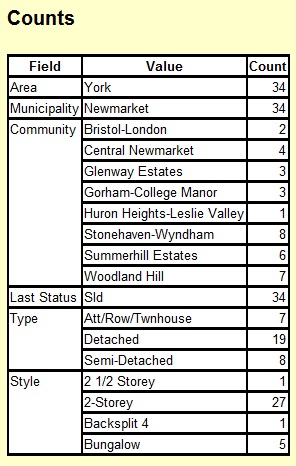
In Newmarket, there were 34 Solds, ranging from $285,000, for a Tidy 2 bedroom Century Semi in the old downtown area,  all the way up to $804,000, for a large 4-Bedroom Wyndam Village home.

Average Sold price was $492,640 while the sold price as a percentage of list price worked out to be a 101.91%. 2 listings, one of which was mine, sold for 111% of asking!

The stat that amazed me the most this past week was which area of town had the most action... Stonehaven -Wyndam Village, with 8 sales, followed by Woodland Hill (New area behind Walmart) with 7 sales.

Take a look at the stats for more info!


Thursday, March 29, 2012

The past week in Newmarket Real Estate (March 22, 2012 - March 29, 2012)

It's amazing what is happening here and hard to keep up with it.
In the past 7 days*, there have been 32 reported sales in Newmarket, ranging from $296,000 to $872,000, with an average of $504,522.

What I consider to be the most amazing sales figure is the percentage of list price. The average of the 32 homes sold in the past 7 days was 101.47% of asking! In one case, a property in the Leslie Valley/Huron heights area sold for 116% of asking @ $497,000, which was $68k over asking.

With the rapid sales, and what some are considering outrageous prices for homes in areas that do not normally achieve such premiums, I am a little concerned about buyers purchasing homes that have less than 25% down, because a more thorough appraisal might have to be done and if the banks loan-value ratios don't match what the buyer offered to pay, then, the buyers will be required to come up with more money to close the deal... As a Realtor working for sellers, I will be ensuring I get a hefty deposit so that the buyers have no option to not close.

I want to close though with this. Newmarket/Aurora is a fantastic place to live and the buyers seem to be coming from the south, likely due to the prices being cheaper than Toronto/Richmond Hill/Vaughan, and as long as the immigration and population figures continue to grow, I'm not sure we will see a drastic drop in the prices... The demand seems to be there, and the option of renting just doesn't seem to be a better choice right now.


*as reported at 12:05pm March 29, 2012

Wednesday, April 27, 2011

Know what to Look for in a Condo


Bill Johnston, TREB President
April 22, 2011 -- Condominium transactions (sales of condo apartments and condo townhouses combined) comprise approximately one in every three resale home transactions in the Greater Toronto Area compared to 25 years ago when condominiums comprised 25 per cent of the market.

There are many advantages to condo living including energy efficiency, proximity to amenities and maintenance free living. There is also a wider selection of condominium housing structures than ever before.

Regardless of the structure all condominium owners hold title to their units and share ownership and responsibility of and for the operating costs of the common elements that comprise the balance of the property.

Maintenance fees, which are paid in addition to your mortgage and property taxes, are directly related to the size of each condominium apartment unit.

While the maintenance fees may include the cost of heat, hydro, building insurance and upkeep of common areas, it is important to understand specifically what is covered in the maintenance fees.

Ask your REALTOR® for help in understanding what your fees will include in the particular condominium you're interested in buying.

Condominium townhouses may also involve maintenance fees. In this case, fees are related to common areas outside of the structure like Snow removal and lawn care.

There are a number of details involved in a condominium purchase that are unique to this housing type. As such, it's wise to work with a REALTOR®, regardless of whether you are buying a new or resale unit.

When buying a new condo unit, buyers should request a disclosure statement. It includes a description of the project's most important features, bylaws that govern the corporation, rules that regulate owners' living environments and the condominium corporation's budget for the first year after registration.

When buying a resale condo, buyers should also request a status certificate, which offers similar information and confirms that the owner is current with common expenses. It's important to speak with your REALTOR® and discuss which conditions are best suited for your offer.

The move-in date for a new condominium is referred to as an occupancy closing, which takes place until the condominium corporation is registered. Again, ask your REALTOR® to help you understand exactly what is and can be expected at closing.

A condominium Board of Directors, consisting of at least three Directors, is responsible for ensuring monies are held in trust, funds are properly invested and records are kept.

Owners meanwhile are responsible for ensuring their units are in good repair and must seek approval for structural changes within them.

To be sure that you are clear as to your responsibilities as a condominium buyer, be sure to talk to a Greater Toronto REALTOR® who can help you find a condominium ideally suited to your lifestyle. For more information visit www.TorontoRealEstateBoard.com


Bill Johnston is President of the Toronto Real Estate Board, a professional association that represents 31,000 REALTORS® in the Greater Toronto Area

Image Source Page: http://urbanrealtytoronto.com/wordpress/2010/08/18/toronto-hotel-boutique-condos-part-2/

Wednesday, March 23, 2011

The 1% solution: 5 tips to help sell your house


By Jennifer Wilson | Wed Mar 23 2011

Whether you’re moving out of town, moving up or splitting up, everyone has the same goal when they’re selling their home: to make as much as they can.

One way to get the best sale price is to invest a few dollars to spruce up your place for prospective buyers. One rule of thumb is that you should set aside 1 per cent of your asking price, so, if you’re listing for $400,000 a renovation budget of $4,000 isn’t out of line.

Of course, certain projects will get you more, though in most cases you won’t get all your money back. The return can be anywhere from nothing, for skylights and pools, to an average of 75 per cent on high-performing kitchens and bathroom projects.

Here are some tips:

Kitchen

You can expect to recover 75 to 100 per cent of your investment in kitchens and bathrooms.

“The payback is tremendous,” says Frank Turco, Home Depot’s trend and design manager. That’s because buyers don’t want to undertake a cumbersome renovation that restricts access to these key spaces.

A few hundred dollars can give your kitchen a whole new look. Cabinets can be cleaned, lightly sanded and painted to look like new, while hardware can also be updated quickly and inexpensively, with new pulls and handles starting at a few dollars a pop. Outdated track lights can be replaced with more fashionable varieties, focused task lighting and undercabinet lighting. Dingy backsplashes can also be refreshed with a coat of paint or new tiles, which are available in peel-and-stick varieties.

For a bit more of a splurge, try replacing laminate cabinets with wood and laminate countertops for something a higher end, such as Corian or granite. New appliances are also a worthy investment, with stainless steel and once again trendy glossy white appealing to buyers.

Bathrooms

In the bathroom, like the kitchen, painting the vanity, and swapping out light fixtures and pulls can refresh the space inexpensively. Upgrading faucets, taps and shower heads are another simple project in the $50 - $100 range.

Additional storage is also essential in the bathroom, so look into closet and cupboard organizing systems and adding extra shelving.

Or go all out and embrace the trend for more spa-like bathrooms with marble tiling, full glass showers with extra nozzles and high-end showerheads or a steam shower. Double sinks, heated floors and upgraded countertops are also nice perks.

Paint

In all spaces, a fresh coat of paint works wonders – bringing homeowners a return of 50 to 70 cents on the dollar, says says Mariano Gigante, a sales representative with Sutton Group. Others like, Re/Max salesperson Justin Kua estimate a fresh paint job can bring in returns of 300 per cent.

“Even if it is a simple thing to fix, buyers want it done,” says Gigante, noting it also helps sell homes quicker than other upgrades. Wipe away scuffed paint and outdated colours with neutral hues for a fresh, buyer friendly look.

Flooring

Ripping out worn carpets and refinishing, or replacing, battered floors can offer returns of 75 to 100 per cent, says Gigante, noting that laminate and wood offer the highest rate of return.

Turco recommends laminate vinyl options, explaining “vinyl has come a long, long way” and is now available in durable planks, tiles and sheets that can mimic almost any look and texture, with many varieties available in the $60 range for 24 square feet. Plus, as far as projects go, it’s “inexpensive and easy, as long as you have a box cutter and a ruler.”

Other upgrades

Replacing doors and windows can bring in 50 to 75 per cent – and help you save on energy costs to boot.

Landscaping, meanwhile, will put roughly 25 to 50 per cent of what you spend back into your pocket. A well-maintained garden, brick paths and even urns can also do a lot to boost your home’s curb appeal.

A buyer’s first impression is key so for an easy fix up under $100, Turco suggests cleaning up the front yard, repainting pots and planters, laying a new welcome mat and painting the front door.

Read about 10 easy ways to boost your home’s curb appeal here.

What not to do

Finishing a basement will see about a 50 per cent return on your investment, but as a big and costly job, Gigante says it’s only worthwhile if the homeowners intend on using it themselves for a while.

Skip the skylight. While additional natural light can be a boost, this project is expected to bring you absolutely no return, says Gigante.

Also avoid adding a swimming pool or Jacuzzi. It usually doesn’t improve your resale value and can even discourage buyers, such as families with small children.

If you are tackling a larger scale reno or working with a contractor, make sure the project comes in at less than your one per cent resale renovation budget, including a hefty contingency fund. The projects that offer the biggest returns – kitchens and bathrooms – can also bring the biggest surprises, snowballing costs as mechanical problems are uncovered.

Jennifer Wilson is the editor of yourhome.ca

Tuesday, February 8, 2011

Roofing Red Flags - CBC Market Place


Click on the following link to watch a eye opening video on how some shady roofers pick your pockets:


Monday, January 17, 2011

New Mortgage Rules from the Department of Finance

The Harper Government Takes Prudent Action to Support the Long-Term Stability of Canada's Housing Market

The Honourable Jim Flaherty, Minister of Finance, and the Honourable Christian Paradis, Minister of Natural Resources, today announced prudent adjustments to the rules for government-backed insured mortgages to support the long-term stability of Canada’s housing market and support hard-working Canadian families saving through home ownership.

“Canada’s well-regulated housing sector has been an important strength that allowed us to avoid the mistakes of other countries and helped protect us from the worst of the recent global recession,” said Minister Flaherty. “The prudent measures announced today build on that advantage by encouraging hard-working Canadian families to save by investing in their homes and future.”

“The economy continues to be our Government’s top priority,” continued Minister Paradis. “Our Government will continue to take the necessary actions to ensure stability and economic certainty in Canada’s housing market.”

The new measures:

1. Reduce the maximum amortization period to 30 years from 35 years for new government-backed insured mortgages with loan-to-value ratios of more than 80 per cent. This will significantly reduce the total interest payments Canadian families make on their mortgages, allow Canadian families to build up equity in their homes more quickly, and help Canadians pay off their mortgages before they retire.

2. Lower the maximum amount Canadians can borrow in refinancing their mortgages to 85 per cent from 90 per cent of the value of their homes. This will promote saving through home ownership and limit the repackaging of consumer debt into mortgages guaranteed by taxpayers.

3. Withdraw government insurance backing on lines of credit secured by homes, such as home equity lines of credit, or HELOCs. This will ensure that risks associated with consumer debt products used to borrow funds unrelated to house purchases are managed by the financial institutions and not borne by taxpayers.

Our Government’s ongoing monitoring and sound underlying supervisory regime, along with the traditionally cautious approach taken by Canadian financial institutions to mortgage lending, have allowed Canada to maintain strong and secure housing and mortgage markets.

The adjustments to the mortgage insurance guarantee framework will come into force on March 18, 2011. The withdrawal of government insurance backing on lines of credit secured by homes will come into force on April 18, 2011.

The Full Article can be read at: http://www.fin.gc.ca/n11/11-003-eng.asp

Monday, September 27, 2010

Home ownership costs soar across Canada


The Canadian Press

Date: Monday Sep. 27, 2010 8:43 AM ET

TORONTO — The cost of owning a home continues to rise, according to a quarterly report on housing affordability by Canada's largest banking group.

The latest housing report by RBC Economics Research says the costs of owning a home increased the most in Ontario and British Columbia.

The higher monthly costs for owning a home were driven by increased mortgage rates and further appreciation in home prices, the report said.

The report said home ownership costs in B.C. neared the all-time highs reached in 2008.

The RBC report also says it expects a temporary easing in housing affordability because of the recent drop in mortgage rates and signs that home prices are stabilizing in many markets.

Click here to read the Report

Tuesday, September 21, 2010

GTA REALTORS® Report Mid-Month Resale Housing Figures

TORONTO, September 16, 2010 ‐ Greater Toronto REALTORS® reported 2,623 sales through the Multiple Listing Service® (MLS®) during the first two weeks of September 2010. This represented a 22 per cent decrease compared to the 3,361 sales recorded during the same period in 2009. Year-to-date sales amounted to 65,455, representing a six per cent increase compared to 2009.

“Sales remain below the record pace we experienced in the second half of 2009. The prospect of higher interest rates and new mortgage lending guidelines resulted in higher than normal sales in the first few months of the year. To balance this out, the pace of sales has slowed in the second half,” said Toronto Real Estate Board President Bill Johnston.

“It is important to note that year-to-date sales remain above the number reported through the same period last year,” added Johnston. The average price for September mid-month transactions was $412,367 – up five percent compared to the average of $393,818 recorded during the first 14 days of September 2009.

“Under current lending standards, the average selling price is affordable for a household earning the average income in the GTA. The annual price growth we have been experiencing has been justified by this positive affordability picture,” said Jason Mercer, TREB’s Senior Manager of Market Analysis.

Monday, May 3, 2010

Money Sense Magazine Ranks Newmarket as 15th Best place to live in Canada

Money Sense Magazine ranks Newmarket as the 15th Best Place to live in Canada.

Click here to read to complete article.

Tuesday, April 27, 2010

End of an Era - Old Community Centre Arena is coming down

As part of a larger vision to transform downtown Newmarket, the Community Centre (200 Doug Duncan Drive) is scheduled to undergo significant renovations, starting with the dismantling of the arena within the next few weeks. Residents and business owners will now notice perimeter fencing surrounding the arena and south parking lot as the contractors prepare for the demolition.

“The Community Centre arena has stood the test of time and has been a pillar of our recreation community since the 1920s. The dismantling of the arena is bittersweet as it represents the end of an era, but also marks the beginning of an exciting transformation for Newmarket,” say Mayor Tony Van Bynen.

The removal of the arena is an important component of the Town’s Community Urban Space Project (CUSP) that will see the creation of an 8.4 acre urban park in the heart of downtown. Touted as an all season destination, the new park will include an open-air skating facility that converts into a summer water feature, and an outdoor performance area. The park is scheduled to open by March 31, 2011.

“As we say goodbye to the old arena, we are creating a new family space in its place,” says Regional Councillor John Taylor. “We’re excited that the new urban park will further promote downtown as a centre for the community and a key destination for cultural and recreational events,” continues Taylor.

The Community Centre itself will undergo a variety of renovations, and the Town will host a public drop-in session to allow members of the community to view the interior and exterior plans for the centre (date to be determined).

Residents should be advised that traffic flow along Doug Duncan Drive may be affected as the arena is dismantled. In addition, contractors in hazardous materials suits may be observed as asbestos tile is removed from the facility, and heavy machinery will be onsite.

The Town will continue to update the media as new information is available. A photo opportunity will also be scheduled once the demolition date is determined. To learn more about the Town’s downtown initiatives, visit http://www.newmarket.ca/en/discoverdowntown.asp, or, sign up for the Town’s new electronic newsletter – the Downtown Dish – by e-mailing downtowndish@newmarket.ca for the Town’s new electronic newsletter – the Downtown Dish

Friday, March 12, 2010

HST and how is will effect the Real Etstae Market


HST Transition Rules

The provincial government has provided rules/guidance on how it will transition to the implementation of the proposed Harmonized Sales Tax.

Background

The provincial government has passed legislation to combine the eight percent Provincial Sales Tax with the five percent federal Goods and Services Tax, creating a 13 percent Harmonized Sales Tax (HST).

- The HST is NOT YET IN EFFECT. The HST will come into effect beginning on July 1, 2010; however, note transition rules below.
- HST will not apply on the purchase price of re-sale homes.
- HST would apply to services such as moving cost, legal fees, home inspection fees, and REALTOR® commissions.
- HST will apply to the purchase price of newly constructed homes. However, the Province is proposing a rebate so that new homes across all price ranges would receive a 75 per cent rebate of the provincial portion of the single sales tax on the first $400,000. For new homes under $400,000, this would mean, on average, no additional tax amount compared to the current system.

Transitional Rules for New Housing

Generally, sales of new homes under written agreements of purchase and sale entered into on or before June 18, 2009 would not be subject to the provincial portion of the single sales tax, even if both ownership and possession are transferred on or after July 1, 2010.
The tax would also not apply to sales of new homes under written agreements of purchase and sale entered into after June 18, 2009 where ownership or possession is transferred before July 1, 2010.

Additional Transitional Rules

Where services straddle the HST implementation date of July 1, 2010, the tax charged for the service may have to be split between the pre-July 2010 and post-June 2010 periods. However, the HST will generally not apply to a service if all or substantially all (90% or more) of the service is performed before July 2010.
Four key timelines are important (see below). All are based on the earlier of the time the consideration is either due (In general, an amount is due on the date of the invoice or the day required to be paid pursuant to a written agreement), or is paid without having become due. If consideration is due or paid,
Before October 15, 2009, HST will generally not apply (however, see above transition rules for new housing).
From October 15, 2009 to April 30, 2010, certain business that are not entitled to recover all of their GST/HST paid as input tax credit may be required to self-assess the provincial component of the HST with respect to goods or services supplied after June 30, 2010.
From May 1, 2010 to June 30, 2010, HST will generally apply for services supplied after June 30, 2010.
After June 30, 2010, HST will generally apply. An exception to this rule would be where ownership of the property is transferred before July 2010 or the invoice relates to services provided before July 2010.
With regard to the lease or license of goods, including non-residential real property, HST will generally apply to lease intervals or payment periods on or after July 1, 2010 and the general rules noted above will apply. However, where a lease interval begins before July 2010 and ends before July 31, 2010, it is not subject to HST.
With regard to the sale of non-residential property, HST is due where both possession and ownership of non-residential property occurs on or after July 1, 2010.


More Detail

Additional detail on the transition rules is available at the provincial government web site here or by calling the provincial government enquiry line at 1-800-337-7222.